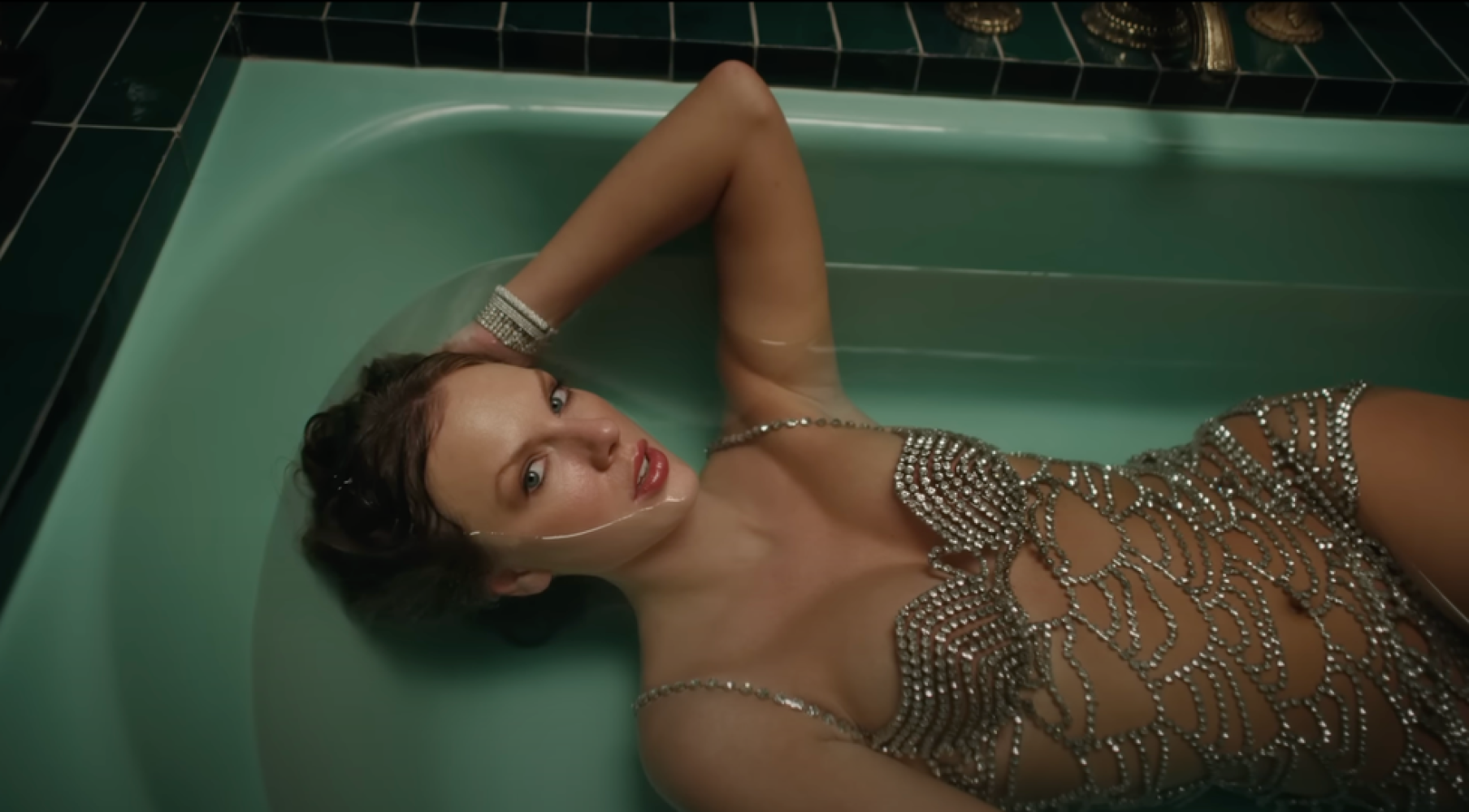
1. Art history isn't a canon, it's an algorithm
Instead of working through "masterpieces" in a tidy line, image history in the Swiftieverse behaves like an online feed: Recognizable motifs get reposted until they're set to autoplay inside our heads. That's exactly what Taylor Swift does in her music video for the number-one hit, "The Fate of Ophelia".
She doesn't summon one version of the literary Ophelia but a whole cluster: the white, water-soaked dress (as in the painting by Friedrich Heyser, 1900), the hands drifting upward (an iconographic evergreen), the melancholy floristry (violet for fidelity, poppy for death, daisy for innocence—the Victorian language of flowers that John Everett Millais painted with botanical precision). Then there's the German variant: Heyser's Ophelia, whose palette—dark olive green, shimmering white fabric, islands of reddish-white blossoms—the video quotes almost one-to-one. Swift stacks further historical takes on top (Arthur Hughes's Ophelia (And He Will Not Come Back Again), John William Waterhouse's Pre-Raphaelite heroines) and, at the same time, flips the whole principle into the present.
2. The museum is dead—long live the museum
The video's opening scene has set off a real-world phenomenon: Teenagers and students are making pilgrimages to Museum Wiesbaden, where Heyser's Ophelia hangs—a painting that few people outside local Art Nouveau circles would ever have pegged as a blockbuster. Suddenly there are lines, guides squeeze in short tours, and the audience brings its own pedagogy along: side-by-side collages, pose comparisons, debates about drapery versus a wet georgette gown.
The museum moves fast: A special tour links song and painting, and anyone who shows up in a Swift or Ophelia outfit gets in free. Two days later, the event is booked out. None of this is a new education strategy. It's social-media logic in the galleries. The channels of reception change (YouTube, TikTok, Instagram), but the venue profits, right down to its programming. The irony? Museums have poured years into audience development. Taylor Swift pulls it off in under four minutes of video.
3. From model to author: Rewriting tragic images of women
For centuries, Ophelia was painting's shorthand for "dying beautifully." Swift shifts the angle: Her pose serves as an opener—and she survives it. She climbs out of the picture and takes over direction, script, and image control. The camera doesn't find a passive corpse. It finds an artist managing her own visual economy.
The clip stages other female archetypes too, and that's no accident but a program. There's the Marilyn Monroe citation (Versace, red bodysuit, short blond wig) as commentary on the "tragic showgirl" narrative; the 1960s girl group (Roberto Cavalli, chain-mail mini) as a tribute to The Ronettes and to a pop sisterhood beyond the male genius; and a 1930s musical number à la Busby Berkeley, all glittering swim caps and classic Hollywood spectacle, this time choreographed in tandem with Mandy Moore. The iconic images remain—but now the women decide how they're shown.
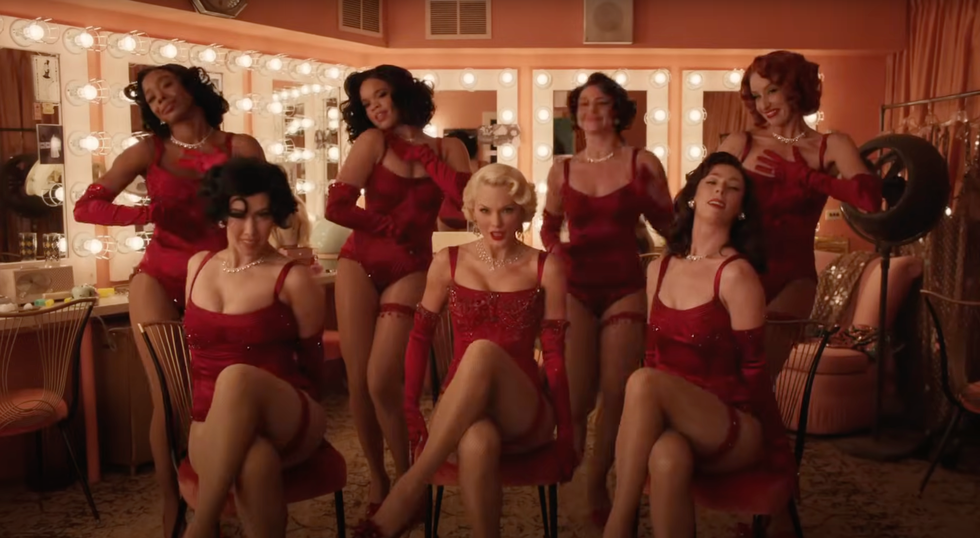
Taylor Swift als Marilyn Monroe
4. Artworks aren't relics—they're loops
For as long as reenactment has existed (from the 18th century tableau vivant to the lockdown meme), motifs have migrated from body to body, from canvas to pose, from picture to performance. The clip is built on exactly that. Its uncut scenes play like stage sets in constant circulation: from the floating Millais moment into the neon chaos backstage, from the theater foyer onto an artificial model ship (with William Etty's The Sirens and Ulysses as subtext), and on into the winch machinery, where a Cavalli rope dress literally hoists the scene.
Walter Benjamin's theory of the "aura" turns on its head. A work's magic isn't lost through reproducibility; it gains through reach. Millions are seeing Heyser's Ophelia for the first time—not instead of a museum visit but before one, as an appetizer for the analog. The digital supplies the hook, the museum the sustain: the resonance and staying power of art.
This is an updated version of an article first published in October 2025.
Watch the video for "The Fate of Ophelia" here: